Sealed and Forgotten
The demolition charge is old — your grandfather's, stored in a rusted tin behind the boiler room — but it holds. You wire it with shaking hands, back down the passage to what you hope is a safe distance, and press the trigger. The ground bucks beneath you like a living thing. Dust and ancient cedar-scented air blast through the corridor, and then there is only the deep, settling groan of ten tons of limestone finding its new resting place. The amber light — that impossible, pulsing amber light — goes dark. The voice, which had spoken your name in a language three thousand years dead, goes utterly silent.
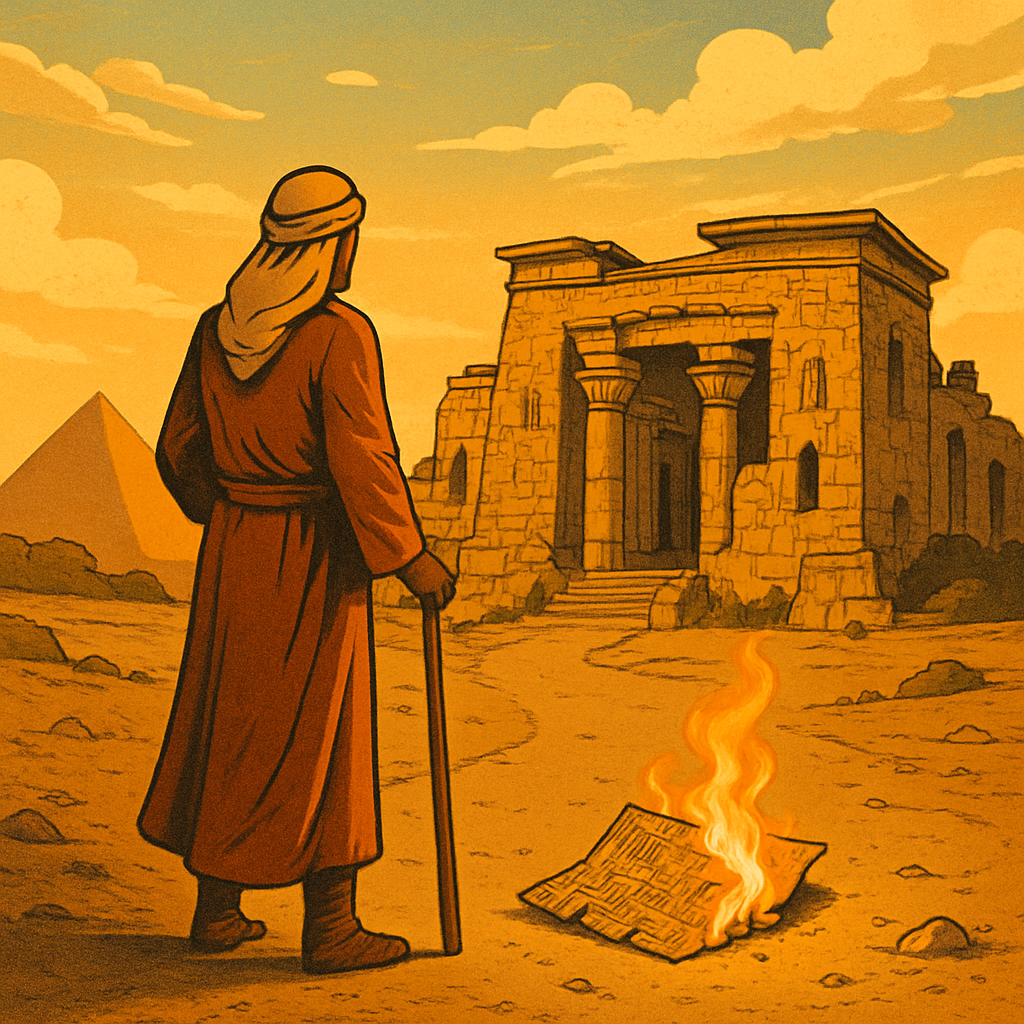
You climb out into a Luxor morning that smells of diesel and river mud and ordinary life. The sun is barely over the horizon, painting the desert in shades of copper and rose. You stand in the road outside the estate's iron gate, the hand-drawn map folded in your pocket. You take it out. You light it with the cheap lighter you bought at the airport, and you hold it until the flame reaches your fingers, then drop the last burning corner into the dust and watch the hidden ink — both layers of it — curl into nothing.
At the airport, you buy a ticket with the last of your cash. You do not look at your phone. You do not call anyone. You sit in the departure lounge with a cup of coffee going cold in your hands and stare at the middle distance, trying to remember what it felt like to be a person with no particular destiny. Other travelers drift past, oblivious. A child laughs at something across the hall. The world is relentlessly, mercifully normal.
But on the plane, somewhere over the Mediterranean, you catch your own reflection in the dark oval of the window. For just a moment — less than a heartbeat — your eyes are not quite your own. You look away. You do not look back. Beneath you, sealed under limestone and silence, something ancient and infinitely patient settles in to wait. It has your name now. It has always had your name. And it is very, very good at waiting.