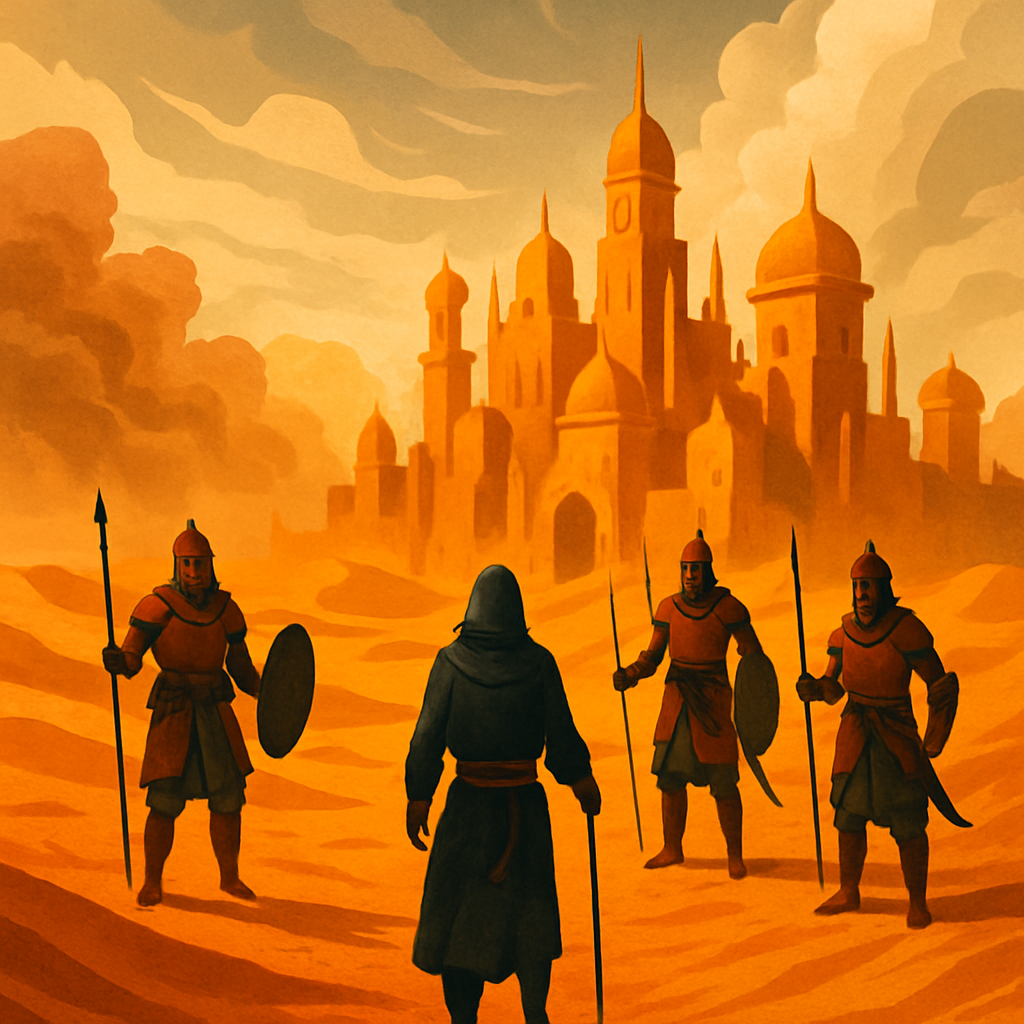
The Amber City
The wall of sand hits you like a living thing — roaring, grinding, tearing at your cloak and stinging every inch of exposed skin. You press forward, one hand shielding your eyes, the other clutching the compass as its needle holds impossibly steady against the chaos. For ten agonizing seconds, the storm is everything. Then, without warning, it isn't.
The silence is so sudden it feels like a blow. You stumble to a halt on smooth flagstone, blinking grit from your eyes, and the world reforms itself around you. Amber towers climb toward a sky that is neither day nor night — a pale, sourceless light filtering down as if the sun itself has been muffled. The towers' surfaces are warm to look at, shot through with deep golden veins, and they hum, a low resonance you feel in your back teeth rather than your ears. The streets are immaculate. The air smells of hot stone and something older, like old parchment left too long in the sun.
You do not have time to reach for your notebook. Figures emerge from doorways and side passages with the practiced efficiency of soldiers who have drilled for exactly this moment — a dozen of them, clad in burnished copper-toned armor, spears leveled, expressions unreadable behind narrow visored helms. They form a circle around you so quickly and so quietly that it seems less like an ambush and more like a closing. One guard steps forward, taller than the rest, and speaks a single word in a language you don't know. The meaning, however, is perfectly clear.
Your compass trembles against your palm, its needle spinning once before locking north — pointing directly at the tallest tower at the city's center. The guards watch it with unmistakable recognition, and the tension in their circle tightens. Whatever you carry, they know what it is. Whatever you are, they have been expecting something like you — and not, you suspect, with any measure of welcome.
Start Over